
IDPC labelled 'undesirable' by the Russian Federation

On July 24th 2026, the Russian Ministry of Justice formally added the International Drug Policy Consortium (IDPC) to the regime’s ever-growing list of ‘undesirable organisations’ based on the work we do to promote human rights and more effective drug policies.
In becoming the 373rd entry on this registry, we find ourselves in good company, as other so-called ‘undesirables’ include: IDPC members – the Eurasian Harm Reduction Association (EHRA) and Human Rights Watch; several of our donors — including the Open Society Foundations (who were among the first to be listed), the Elton John AIDS Foundation and the Robert Carr Fund; and other IDPC partners and notable names such as Amnesty International, Chatham House, the Eurasian Network of People Who Use Drugs (ENPUD) and Greenpeace.
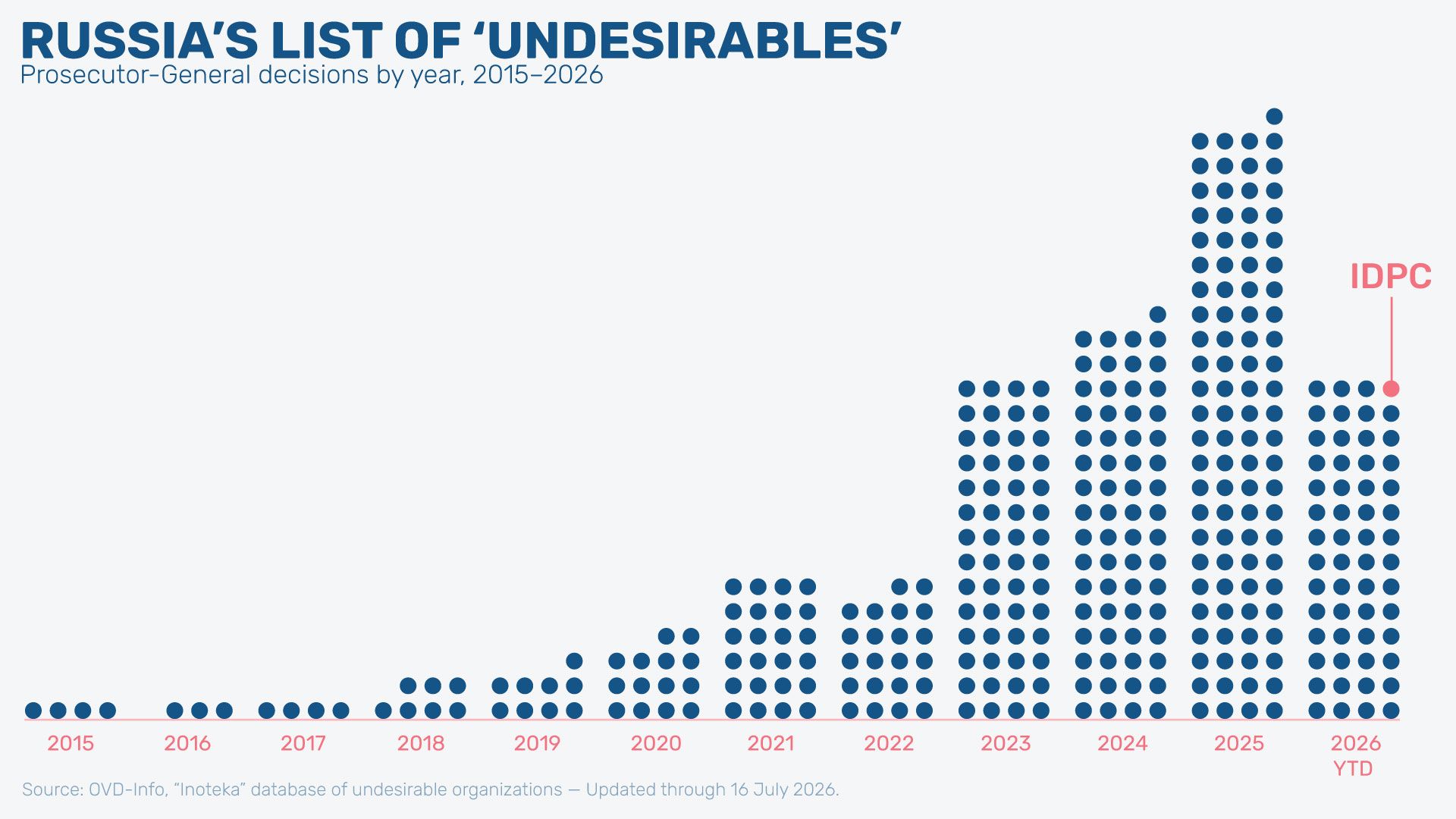
Under Federal Law 129-FZ from 2015, Russian authorities may declare any international organisation as being ‘undesirable’ if it is deemed to threaten ‘the foundations of the constitutional order of the Russian Federation, the country’s defence capability, or state security’. However, it is clear from how the law has been utilised since that this is just one of many attempts by the Russian regime to stifle, silence and threaten civil society for speaking against human rights abuses, punitive policies and war crimes. Indeed, civil society organisations are the most common target of the ‘undesirable organisations’ regime, and new designations sharply accelerated following Russia’s full-scale invasion of Ukraine in 2022.
Furthermore, in 2024, the European Court of Human Rights ruled that the ‘undesirable organisations’ regime violated freedom of association and of expression, created significant legal uncertainty, and lacked safeguards against abuse. Defying the Court’s binding judgement, Russian authorities have since doubled down.
As IDPC does not have projects, offices, staff, events or members in Russia, this designation has no immediate impact on our work. That said, designated organisations are effectively prohibited from operating in Russia, which includes bans on events and the distribution of materials (whether online or offline), while being exposed to surveillance and subsequent proceedings that can lead to asset confiscation. Moreover, individuals and organisations in Russia deemed to collaborate with designated organisations and their activities can face administrative penalties and criminal charges that may lead to imprisonment for up to six years.
Unfortunately, we therefore caution any Russian citizen, resident or organisation not to share or promote any of IDPC’s resources or reports — even on social media — and suggest deleting previous posts relating to our work. This includes the Support Don’t Punish campaign, which IDPC remains proud to host and facilitate. Even continuing to receive the IDPC Monthly Alert newsletter could carry risks for Russian citizens or others based in Russia.
IDPC does not have any network members from Russia since the Andrey Rylkov Foundation for Health and Social Justice was sadly forced to close operations after years of repression and sanctions from the Russian government for promoting and delivering harm reduction services in the country.
The Russian Federation has one of the most stubbornly punitive drug policies in the world. Opioid agonist treatment using methadone or buprenorphine is completely banned in the country despite being globally recognised as a gold standard and included in the WHO Model List of Essential Medicines. IDPC’s Global Drug Policy Index scored Russia at just 41/100 — with especially low scores for proportionality, health responses and access to controlled medicines. These damaging policy choices harm, first and foremost, people in Russia. Around 30% of the country’s large prison population is estimated to serve sentences for drug-related offences, often in conditions that further worsen health and life outcomes. HIV prevalence among people who inject drugs stands at 26%, nearly four times the global median. Stigma, punishment and criminalisation expose people to withdrawal without adequate treatment, rights abuses, and heightened risks of transmissible diseases. And this punitive logic goes beyond drugs: sex workers, LGBTQ+ people, and other marginalised communities face discriminatory treatment and repression that erect barriers to accessing care, while rights defenders and community-led organisations invested in their protection are under attack.
IDPC remains completely undeterred from our core mission: to amplify and strengthen a diverse global movement to repair the harms caused by punitive drug policies, and promote just responses.
At the United Nations level, IDPC has frequently stood up to resistance from Russia and other countries to health- and rights-based approaches, advocating instead for what decades of evidence make clear: harm reduction, decriminalisation and community leadership work.
We strongly condemn these attempts to shut down civic space and critical debate, and stand in solidarity with the organisations on this list targeted for their commitment to health, rights and freedoms, as well as with all of those impacted by the Russian regime’s failed wars, whether on drugs or on its neighbours.