
Steve Rolles
Stubborn progress in a fractured system: Reflections on a CND in transition
March 2026 marked my final UN Commission on Narcotic Drugs (CND) as Executive Director of IDPC. Sitting in the plenary, watching yet another round of fraught negotiations unfold, I found myself thinking back to my first CND in 2009—and just how much has changed but also the cyclical nature of geopolitics.
Harm reduction – full circle?
At my first CND, I watched a group of member states fight valiantly to include the term “harm reduction” in the 2009 Political Declaration— only to be forced to accept a last-minute compromise to include the term “related support services”. Germany, speaking on behalf of 25 countries, clarified that they would interpret the term “related support services” used in the Political Declaration “as including measures that a number of States, international organizations and non-governmental organizations called “harm reduction measures”. The CND’s reliance on consensus had allowed a small number of countries, notably Russia and the United States, to block explicit, evidence-based language. That dynamic would hold for more than a decade, right up until the so-called “Vienna consensus” began to unravel in 2024.
Seventeen years later, I returned to Vienna for my final CND in this role—and this time, “harm reduction” was back on the table as part of a resolution on a broader, comprehensive public health framework, tabled by Norway and Finland. Its inclusion is not just symbolic. It reflects the slow, often frustrating, but ultimately undeniable shift in CND debates over the past two decades: a growing recognition that harm reduction is a rights-based, evidence-driven, and fundamentally humane response to drugs.
This shift began to crystallise in 2024, when harm reduction was explicitly included in a CND resolution for the first time—ironically led by the United States under the Biden administration. Russia called for a historic vote, breaking with decades of consensus practice. The 2024 resolution was backed by 38 of the 53 countries with a vote (with 6 abstaining, 7 absent and only China and Russia voting against).
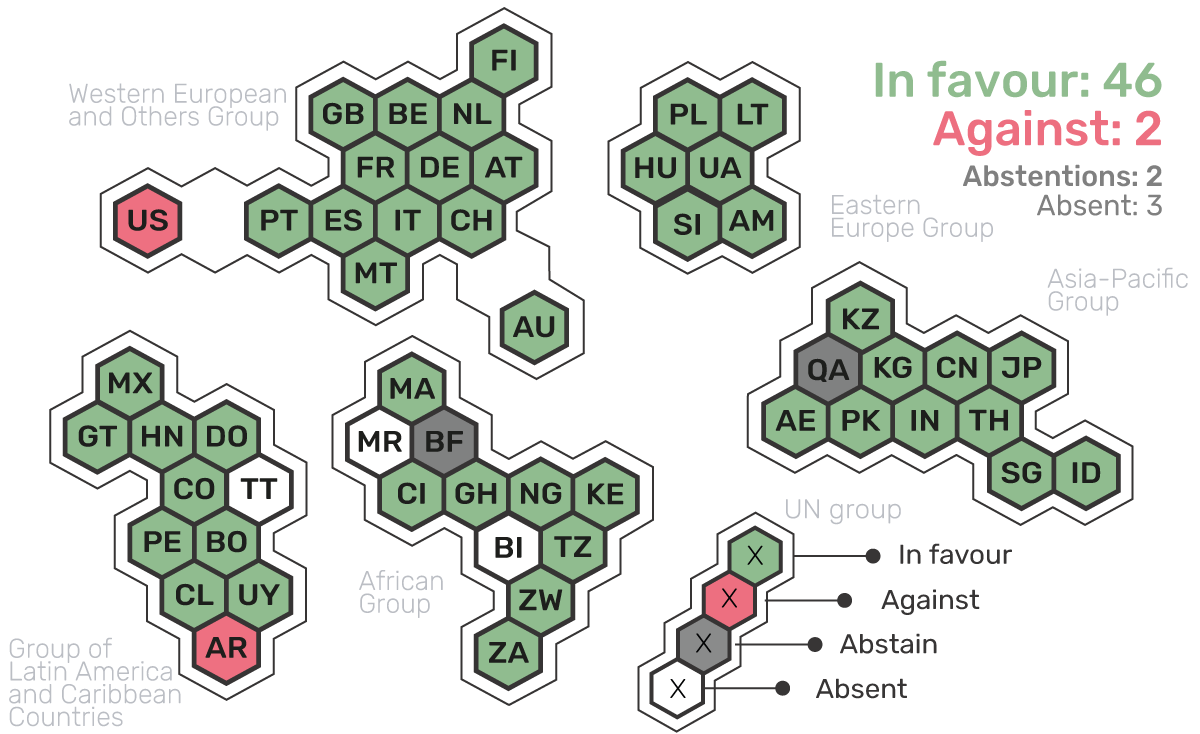
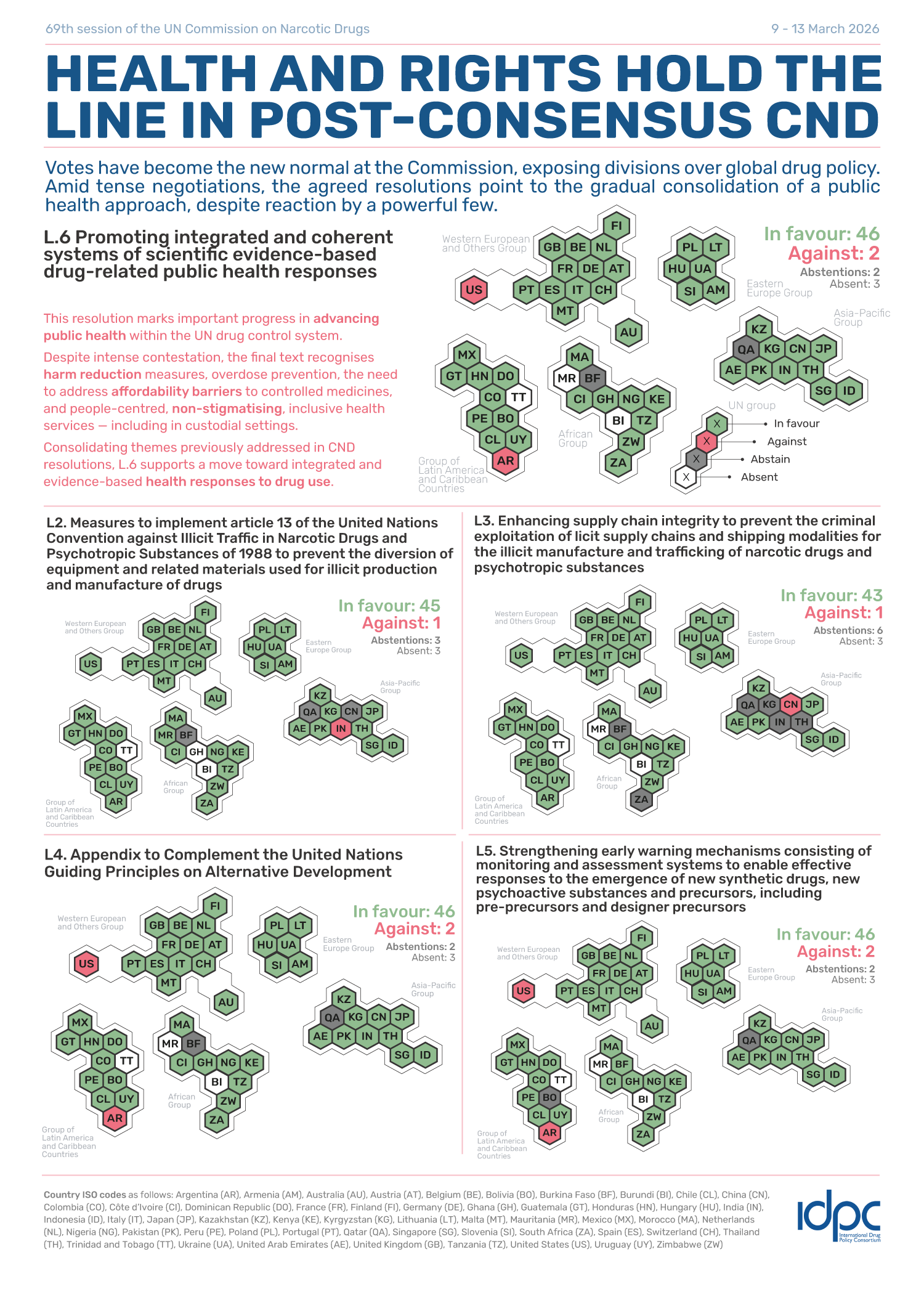
By 2026, the landscape had shifted again. The Norway/Finland resolution, which contains many positive commitments in addition to the specific reference to harm reduction, was adopted with 45 votes in favour—including China. Burkina Faso and Qatar abstained; only the United States and Argentina voted against. The United States, now under a very different administration, called for the vote and argued that harm reduction “contributes to the normalisation of drug use”— a 180-degree (but not unexpected) U-turn from their position of leadership and coalition building in 2024. Crucially, Russia – stripped of CND voting rights for the first time this year – had also agreed to the resolution text around the negotiating table. As one delegate remarked to me: “That is as close to consensus as you can get nowadays”. But diplomatic compromises were made to achieve this result and to ensure that as many States as possible voted in favour (or at least abstained). It is likely that the desire to isolate the United States – who objected during negotiations (and throughout the CND – more on this below) to references to the World Health Organisation (WHO), the Sustainable Development Goals (SDGs) and gender rather than explicitly to ‘harm reduction’. The compromises accepted include a footnote declaring that “Harm reduction is not a universally agreed concept among Member States”, and UNODC’s contested language that all responses are “part of a recovery-oriented continuum of care”.
The CND’s self-imposed taboo over ‘harm reduction’ has been broken for good, but the strategic gain does leave us with language that needs to continue to evolve and strengthen in the coming years.
Voting is the new normal
The 69th CND unfolded against a backdrop of deep geopolitical fragmentation, with the US once again at its centre. In this context, one of the most significant procedural shifts of recent years has now firmly taken hold: voting has become the norm.
For the second consecutive year, every resolution went to a vote on the final day. India called a vote on a Mexico-led resolution. China called a vote on a US resolution. And the US led the charge against the other three resolutions (driven by its domestic reactionary agenda against any mentions of gender, sustainable development, the WHO, etc).
This new reality is reshaping how negotiations unfold. One notable example was the alternative development resolution led by Thailand, Germany and Peru which included a lengthy annex to update and complement the 2013 UN Guiding Principles on Alternative Development. Faced with entrenched US opposition to core concepts such as the SDGs, the sponsors ended negotiations early and submitted a final draft on which they were not willing to compromise further after just two days of the CND (Tuesday 10th March). It was a pragmatic recognition that prolonged negotiations were unlikely to yield further progress and that the resolution would ultimately be taken to a vote. This approach contrasted with the resolution sponsors who still sought to find consensus and continue negotiations right up until the close of play on Thursday. The resolution ultimately passed with 46 votes in favour, opposed only by the United States and Argentina. But Russia hinted in its closing remarks that it may seek to reopen the text at ECOSOC—a move that, if pursued, could fundamentally undermine the authority of the CND as an operational commission.
At the same time, we are seeing the emergence of a two-tier system of “agreed language”. Whereas “agreed language” from previous resolutions was often a safe choice for new documents, on several occasions during negotiations this month, member states showed resistance to “agreed language” from resolutions that they did not vote for (such as on the issue of harm reduction from the 2024 resolution). Again, this has big implications for how future resolutions are drafted and steered to adoption.
The United States: isolated, yet disruptive
Another defining feature of this year’s CND was the posture of the US and the Trump Administration’s disdain for international law, diplomacy and multilateralism. For the second year in a row, the US came to the CND with an incredible show of arrogance and inflexibility – although their overall tone was perhaps more conciliatory than last year, inviting other countries to join a renewed ‘war on drugs’ and securing a seat for their candidate on the independent expert panel created to review the drug control machinery. However, they remained extraordinarily isolated in their ideological push against gender, sustainable development and the WHO. It is remarkable, and welcome, that the world’s self-proclaimed pre-eminent superpower was only able to get Argentina to vote with it – while new global alliances form in opposition to the US positions.
More troubling, however, was the broader narrative shift. Security-based approaches dominated the discourse. Even traditional champions of public health—Canada and several EU member states among them—placed greater emphasis on supply reduction in their statements. The opening statements by the UNODC and the International Narcotics Control Board (INCB) reinforced this trend and emphasised border control and interdiction (as clear funding pitches to the US). In return, the USA made no apologies for its resurgent ‘war on drugs’ rhetoric – boasting about the use of lethal military force, highlighting initiatives such as the “Southern Shield” coalition and the forcible capture of Nicolás Maduro.
These developments raise profound legal and ethical concerns. Since the launch of ongoing military operations against so-called “narcoterrorist” boats, more than 150 people have reportedly been killed. Little is known about their identities, or whether they were in fact involved in drug trafficking— though even that does not justify extrajudicial force. Such actions stand in clear violation of international law, human rights law, and the drug control conventions themselves as has been previously clarified by the INCB.
And yet, at CND, these issues were largely left unchallenged — with Brazil being a rare exception. The intervention by the UN Special Rapporteur on counter-terrorism and human rights was one of the strongest I have ever heard in plenary — calling on member states to differentiate clearly between terrorism and drug trafficking and providing a sobering list of the human rights risks associated with their conflation.
A system under strain
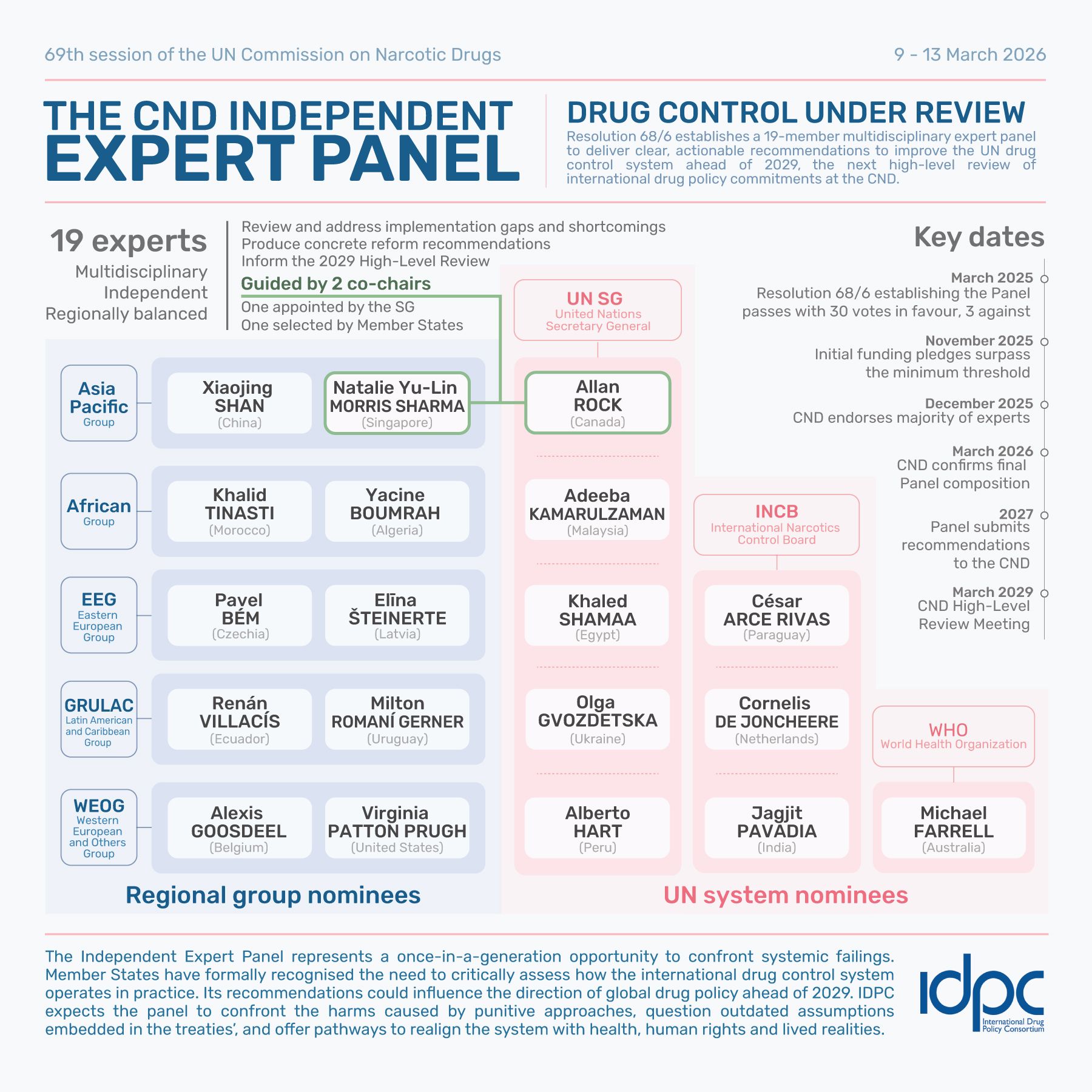
The politics surrounding the independent expert panel offered a final illustration of the current moment. After securing the nomination of its candidate, the US withdrew her candidacy for co-chair— clearly sensing a lack of support, not least because of concerns over geographical representations (the other co-chair having already been confirmed as Allan Rock from Canada). In a surprising twist, Morocco also withdrew its candidate, Khalid Tinasti, at the last minute, seemingly under political pressure from the US. This left Singapore’s nominee, Natalie Y-lin Morris-Sharma, to be appointed to the role unopposed.
These manoeuvres speak to a broader reality: the multilateral system is under acute strain. In little more than a year, President Trump has jeopardised the financial viability of the United Nations (including UNODC), threatened its long-standing allies, and openly violated the UN Charter with military aggression, kidnappings and wars. There is nothing new in the US instrumentalising the ‘war on drugs’ for the sake of its geopolitical ambitions. But the shameless disregard for international law and peace presents a new challenge to the multilateral system that weighed heavily on many attending the CND.
From 2009 to today: progress, people and persistence
As I reflect on my last time at the CND as IDPC's Executive Director, I am filled with mixed emotions. Despite deep and worrying geo-political fractures, we have made meaningful progress - most powerfully encapsulated in the political recognition of 'harm reduction'. I can't help but think back to 2009, when such an explicit mention seemed so far out of reach.
The other big and hard-won shift, instrumental to progressive debate, is the hugely expanded space for civil society in this setting. The IDPC network and our allies have truly changed the terms of the debate in Vienna, bringing lived experiences to the fore, highlighting the human cost of punitive policies, engaging the UN human rights system, and mobilising other UN entities on health and development.
I leave this role with a deep gratitude for, and pride in, my civil society colleagues and friends. Without our collective advocacy, the CND debate would not be what it is today. We have centred human rights, harm reduction, health and development outcomes in these deliberations. But these debates are not abstract. The words negotiated in Vienna shape policies that affect the health, dignity and lives of people around the world. Progress has been uneven, often hard-won, and never guaranteed but it matters. The struggle for reform is far from over. But the movement is strong, united, persistent and unafraid to demand change.