
Ludovic Courtès - Wikimedia Commons - CC BY-SA 3.0
63rd session of the UN Human Rights Council
The 63rd session of the UN Human Rights Council brings together Member States, UN experts, civil society and other stakeholders to consider a wide range of human rights issues. The session provides an important opportunity to advance discussion of the human rights implications of drug policies and to promote approaches grounded in human rights, public health, evidence and the meaningful participation of affected communities.
The 63rd session of the UN Human Rights Council offers important opportunities to advance scrutiny of the human rights impacts of drug policies and promote approaches grounded in human rights, public health and evidence. Drug policy will feature prominently during the session, including through two important reports focusing respectively on the impact of drug policies on women and girls and on racial discrimination in drug law enforcement. Civil society, UN experts and Member States will also come together through a series of side events addressing gender, racial justice, Indigenous Peoples’ rights and broader efforts to bring international drug policy into closer alignment with human rights.
Key drug policy reports
Two particularly significant reports dedicated to drug policy will be presented during HRC63.
- The OHCHR study on the impact of drug policies on the rights of women and girls (A/HRC/63/56) examines the human rights impacts of drug laws, policies and programmes on women and girls; efforts to mainstream gender and ensure women’s participation in the development, implementation, monitoring and evaluation of drug policies; and approaches to addressing the specific needs of women and girls.
- The Expert Mechanism to Advance Racial Justice and Equality in Law Enforcement will present its thematic report A/HRC/63/72, alongside the report of its country visit to Colombia, A/HRC/63/72/Add.1. The reports examine how the design and enforcement of drug laws and policies affect Africans and people of African descent, tracing the historical and structural roots of racial discrimination in drug control and addressing impacts including racial profiling, over-incarceration, excessive use of force, arbitrary arrest and detention, and harsher sentencing.
HRI briefing: Drug policy opportunities at HRC63
Harm Reduction International has published a briefing mapping the main opportunities for advancing drug policy issues throughout the 63rd session. In addition to the reports highlighted above, the briefing identifies discussions touching on the right to health, the death penalty, Indigenous Peoples’ rights, racial justice, arbitrary detention and Universal Periodic Review outcomes, and sets out opportunities for Member States and civil society to bring the human rights consequences of punitive drug policies into these debates.
63rd Human Rights Council: Drug Policy Opportunities is available here.
Side events
A number of side events will provide spaces for Member States, UN mechanisms, civil society and affected communities to discuss the intersections between drug policy and human rights during HRC63.
- Women, Girls and Drug Policies: Advancing a human rights approach
28 September | 13:00–14:00 | Room V, Building A and online
Organised by OHCHR, the event will present key findings from its report on the impact of drug policies on women and girls, highlight promising practices in implementing human rights-, health-, gender-sensitive and evidence-based drug policies, and strengthen dialogue between Council members, UN entities, affected communities and civil society. Online access. Flyer. - Drug Control and Human Rights: from parallel universes to emerging convergence
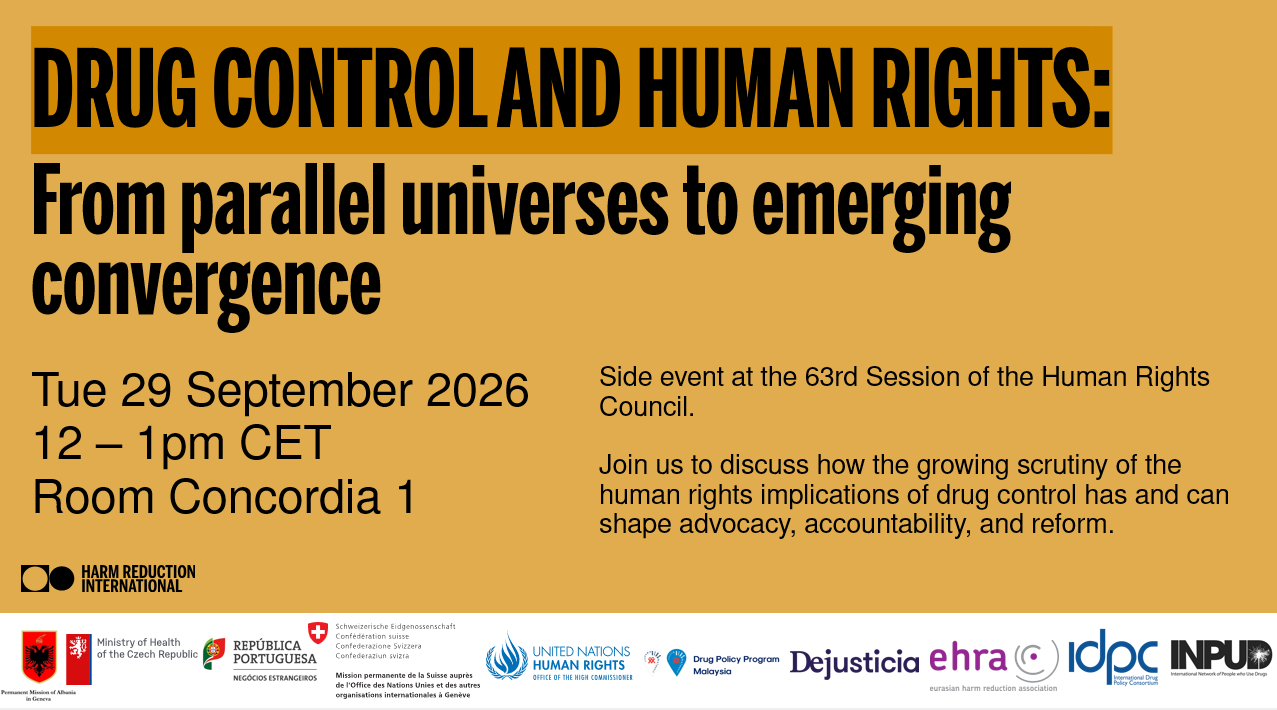
29 September | 12:00–13:00 | Room Concordia 1
Organised by Harm Reduction International, this event will examine the growing convergence between drug control and human rights over the past two decades. Discussions will consider the increasing attention paid by UN human rights mechanisms to the harms of punitive drug policies, how communities and civil society can use international human rights standards in their advocacy, and opportunities to advance more coherent and rights-based drug policies. Flyer. - Systemic Racism and Drug Policy Enforcement
30 September | 12:00–13:00 | Room V, Building A and online
Co-hosted by the Expert Mechanism to Advance Racial Justice and Equality in Law Enforcement and OHCHR, the event will explore systemic racism in drug policy and law enforcement, building on the Expert Mechanism’s findings on the impact of drug laws and policies on Africans and people of African descent. It will bring together Member States, UN entities and civil society to discuss discriminatory impacts and pathways towards drug policies grounded in human rights, public health and racial justice. Registration here. Flyer. - From Flawed Review to Real Change: Indigenous and peasants’ rights and the future of the coca leaf
1 October | 13:00–14:00 | Room Concordia 1 and online
Organised by the International Drug Policy Consortium, this event will bring together civil society, UN experts and government officials to discuss the future of the coca leaf following its international review, including possible mechanisms to protect the plant and ongoing initiatives in the Andean region. Crucially, the discussion will feature the perspectives of Indigenous coca farmers. Register here for online access. Flyer. - Extra Punishment: Violence Against Women in the Fight Against Organized Crime
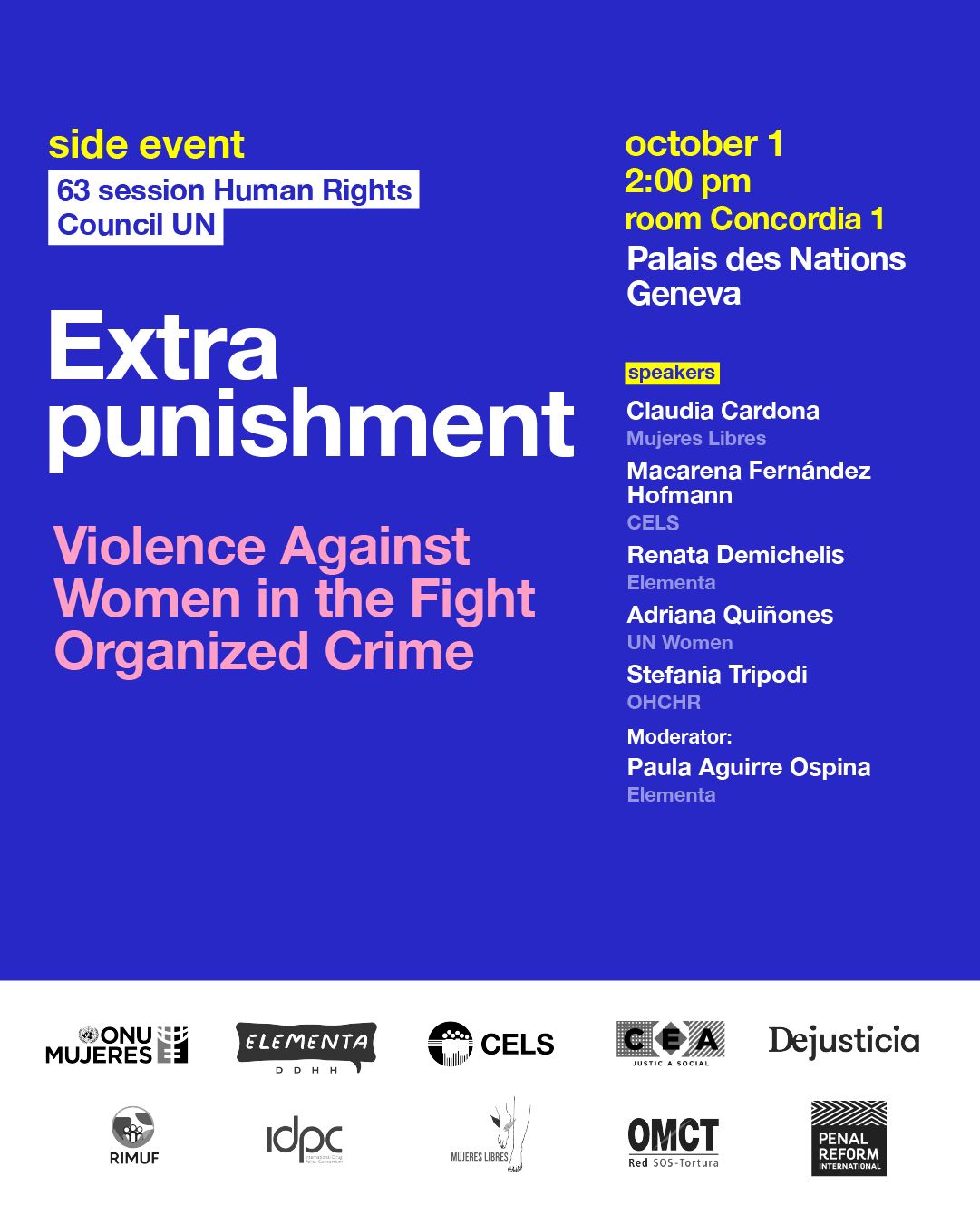
1 October | 14:00–15:00 | Room Concordia 1
Co-organised by Centro de Estudios Legales y Sociales (CELS), Dejusticia, Elementa and Mujeres Libres, this event will examine how policies targeting organised crime produce disproportionate and additional harms for women in Argentina, Colombia and Mexico. Discussions will address impacts across arrest, judicial proceedings and incarceration, including physical and sexual violence, extortion, violations of defence rights, incrimination by association, and barriers to prison benefits and alternatives to incarceration. Flyer.
Satellite events
- Youth and Drugs: Rethinking the Rules / Les jeunes et la drogue : repenser les règles
30 September | 18:30–20:00, followed by a reception | Room MS150, University of Geneva (UNIGE), Uni Mail
Organised by the Global Commission on Drug Policy, Geneva Health Forum and the Faculty of Medicine at the University of Geneva, this satellite event will examine how drug policies affect the rights, health and well-being of children and young people. Following the launch of the Global Commission’s new policy brief, Making Children and Young People Visible in Drug Policy: A Child Rights-Based Agenda for Reform, the discussion will address punitive approaches to drugs, meaningful participation by young people, human rights, and evidence on prevention, treatment, harm reduction and public health. Registration is mandatory.
Regions
Related Profiles
- United Nations Human Rights Council
- International Drug Policy Consortium (IDPC)
- Harm Reduction International (HRI)
- Mujeres Libres Colombia
- Office of the United Nations High Commissioner for Human Rights (OHCHR)
- UN Expert Mechanism to Advance Racial Justice and Equality in Law Enforcement (EMLER)
- Centro de Estudios Legales y Sociales (CELS)
- Dejusticia
- Elementa, Consultoría en Derechos